.png)


Polymer Odor Capture and Release (POCR / Getxent®) || The Science Behind Real Odor and Reliable K9 Detection Training


Hello science lovers!
We're excited to continue sharing educational articles designed to support handlers, trainers, and K9 programs with accurate information, research-backed methods, and practical detection dog training solutions. Our goal is not just to describe what our products are, but why they work — and why certain training approaches are safer, more effective, and more defensible than others.
One of the most impactful tools enabling safer and more realistic detection dog training today is Polymer Odor Capture and Release (POCR) technology. In this article, we’ll break down what POCR is, how it’s impregnated with odor, what the science actually shows, and how Precision Explosives applies POCR across our detection training products.
What Is POCR (Polymer Odor Capture and Release) - and Why It Matters
Detection dogs don’t alert to a substance in the way humans think about it. They alert to odor signatures, which are complex mixtures of volatile organic compounds (VOCs). These VOCs evaporate from materials and create the scent profile a dog learns to recognize and discriminate.
Historically, detection training has relied on either live target materials or synthetic odor approximations. Live materials introduce obvious safety, regulatory, and handling risks. Synthetic odors, while safer in many cases, can oversimplify or misrepresent the true odor profile a dog will encounter in operational environments.
POCR exists to bridge that gap!
Polymer Odor Capture and Release uses a specialized polymer material designed to capture VOCs from a real odor source, retain them within the polymer matrix, and then release those compounds gradually over time during training. The goal is to expose the dog to the same odor signature, without exposing the handler or the dog to the hazardous substance itself.
In short, POCR allows teams to train realistically - without unnecessary risk.

Why Use POCR / Getxent® in Detection Dog Training
What makes POCR especially valuable in detection dog training is how much control it gives trainers without sacrificing realism.
Dogs trained using POCR-based aids are exposed to real target odor profiles rather than simplified substitutes. At the same time, the polymer itself is a non-hazardous carrier in its blank state, designed for safe handling and storage. Because odor is captured and released in a controlled way, trainers can achieve consistent odor presentation across repetitions, environments, and training days.
This also reduces the need to routinely handle, store, or deploy hazardous substances. POCR-based training aids can be used in vehicles, buildings, mailrooms, and field scenarios without introducing the logistical and safety challenges associated with live materials.
Just as importantly, POCR isn’t just a concept — it’s supported by analytical testing using SPME–GC–MS odor profiling, giving handlers and agencies data they can stand behind.
How POCR Is Impregnated With Odor
At a high level, POCR impregnation relies on controlled exposure, not direct contact. The polymer media is placed in a sealed environment containing the target odor source. Over time, VOCs migrate from the source into the polymer. How much odor is captured depends on several factors, including exposure duration, source concentration, and environmental conditions.
Once impregnated, the polymer can be transferred to a clean container and allowed to equilibrate before deployment. During training, it releases odor molecules at a controlled and repeatable rate, creating a stable scent presentation well suited for imprinting, maintenance training, and scenario-based work.
One important takeaway - supported by laboratory testing - is that time matters. Longer impregnation periods can increase the concentration of released odor compounds without changing the overall structure of the odor profile. This has real implications for consistency and repeatability in professional training programs!
The Science: What Analytical Testing Shows
1) Analytical and Operational Validation of POCR for TATP K9 Detection
Analytical testing is important, but for detection dog programs, chemistry alone isn’t enough. The real question is: can a Polymer Odor Capture and Release training aid translate laboratory fidelity into reliable K9 performance?
This study is particularly relevant because it evaluates POCR technology using TATP, a highly volatile and dangerous homemade explosive that presents significant handling and storage risks in traditional training. In the study, researchers evaluated a POCR training aid using both chemical analysis and live detection dog trials, bridging the gap between laboratory performance and operational use.
From an analytical perspective, the POCR aid produced an odor concentration comparable to a 1-gram laboratory training aid fitted with a 13-hole lid - a configuration commonly used to allow controlled vapor release in explosive detection training. This finding is important because it demonstrates that POCR aids can produce odor availability within the same practical range as conventional training aids, without containing the hazardous explosive itself. More importantly, the study evaluated how dogs trained using the POCR aid actually performed.
Across multiple test phases, canine alert rates exceeded 80 percent, indicating consistent detection performance. Dogs that were specifically imprinted on the POCR aid demonstrated even stronger results, with alert rates exceeding 90 percent, while maintaining low false-alert rates below 10 percent!
Taken together, these results show that POCR technology is not only capable of reproducing relevant odor profiles in the lab, but also supports reliable, operationally meaningful detection behavior in trained dogs.
This study is especially valuable because it validates POCR technology in the context that matters most to handlers and agencies: real dogs, real searches, and a real-world hazardous target. It reinforces the idea that POCR-based training aids can serve as effective, lower-risk alternatives to live materials while still supporting high-level detection performance.
2) “Parent Odor Fidelity” (REPGET22-008 – Camel® Tobacco)
One of the most common questions handlers ask is simple: Is this really the same odor?
A performance assessment conducted by an independent laboratory addressed that question directly. Researchers compared pure Camel® tobacco to a Getxent® (POCR) tube impregnated with Camel® tobacco odor using SPME-GC-MS (solid-phase microextraction gas chromatography-mass spectrometry) - the standard analytical method for evaluating odor profiles.
Under defined analytical conditions, the chromatogram of pure tobacco showed 80 detectable peaks above the instrument’s sensitivity threshold. The chromatogram of the impregnated POCR tube showed the same 80 peaks, using the same integration criteria. From an analytical standpoint, this means the impregnated polymer reproduced the same detectable odor profile as the source material within the GC-MS measurement window. In practical terms, this supports the concept often referred to as “parent odor fidelity” - the idea that the polymer is capturing and releasing the same odor signature the detection dog would encounter from the real source.
This kind of data is important because it moves the discussion beyond marketing claims and into measurable outcomes! Read the report yourself here:
3) Clean Media + Time-Dependent Odor Loading (REPGET22-010 – Cadaver/Hand Odor)
A second performance assessment examined two additional questions that matter just as much in real-world training: Is the polymer itself clean, and how does impregnation time affect odor output?
In this study, analysts evaluated empty vials, non-impregnated Getxent® tubes, and Getxent® tubes impregnated with cadaver odor for 24 hours and 72 hours. All samples were analyzed using SPME-GC-MS, with compound identification performed using the NIST database.
The non-impregnated tube showed only minimal background signals consistent with known analytical artifacts, supporting the conclusion that the polymer media is analytically clean prior to impregnation.
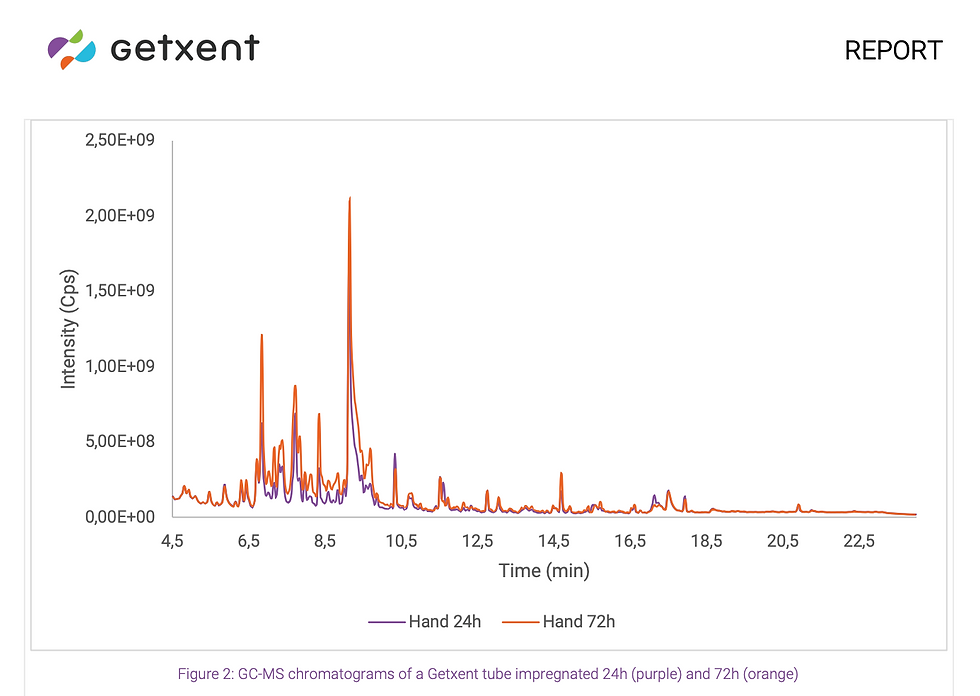
After impregnation, both the 24-hour and 72-hour samples showed 167 detectable peaks, indicating that the overall odor profile complexity remained consistent across time. When researchers examined individual compounds more closely, they observed that the concentration of several volatile organic compounds increased significantly with longer impregnation time - some modestly, others dramatically.
What this tells us is important: POCR can reliably capture and release complex odor profiles rather than a narrow subset of isolated compounds. At the same time, impregnation duration can be used as a controlled variable to influence odor intensity while maintaining profile structure.
For professional training programs, this kind of control matters! View the report yourself here:

Additional research has also examined how environmental factors such as humidity, airflow, transportation, and deployment affect POCR performance. These studies show that operational use does not significantly impair the chemical headspace odor output of POCR aids - an important consideration for training consistency outside of controlled laboratory settings.
In other words, POCR doesn’t just work in the lab. It holds up where training actually happens.
Real odor that dogs find... Science that checks out... Why aren't you using POCR again?
Is POCR / Getxent® Safe? (Getxent® Tube MSDS)
Equally important to performance is safety for your teams!
According to the Getxent® Material Safety Data Sheet, the blank POCR tube material is a polymer blend that is not classified as dangerous under EC criteria. In its blank state, the material is odorless and is not expected to contain a wide range of regulated or hazardous substances.
From a practical standpoint, this means the training aid can be handled, stored, and deployed safely when used as intended. Storage recommendations focus on preserving performance rather than mitigating hazard: keeping the material clean, dry, out of direct sunlight, and ideally stored between 0°C and 25°C.
This distinction between a safe carrier and a controlled impregnation process is what allows POCR-based training aids to reduce risk without sacrificing realism.
Why POCR Is One of the Best Options for Detection Dog Training
When viewed together, the analytical data and material characteristics explain why POCR has become a preferred option for so many professional detection programs.
Dogs are exposed to real odor signatures, not simplified approximations. Handlers are not required to routinely handle or store hazardous materials. Training aids can be deployed across vehicles, buildings, mailrooms, and outdoor environments without introducing unnecessary risk or regulatory complexity.
Just as importantly, POCR-based aids support repeatability - a critical factor in building reliable detection behavior over time!
How Precision Explosives Uses POCR in Our Products
Precision Explosives incorporates POCR / Getxent® technology across multiple detection training aids so handlers can choose the format that best fits their training needs and goals.
This includes Odor Prints designed for durable, repeatable placement; POCR-charged tubes for flexible scenario building; TADDs for advanced training environments; and blank controls for proofing and quality assurance.
Across all formats, the underlying goal remains the same: realistic odor exposure, consistent performance, and safer training workflows for both K9s and handlers.
Conclusion
Polymer Odor Capture and Release technology represents a meaningful advancement in detection K9 training because it focuses on what dogs actually detect - complex odor signatures - while addressing the real-world constraints of safety, consistency, and operational practicality.
Independent laboratory assessments using SPME-GC-MS support key performance concepts such as parent odor fidelity, clean carrier media, and time-dependent odor loading. Combined with clear material safety guidance, these findings help explain why POCR has become a cornerstone technology in modern detection training.
To learn more about Odor Prints, TADDs, POCR, and other detection K9 training aids, visit the Precision Explosives training aid page or contact our experts.

Comments